
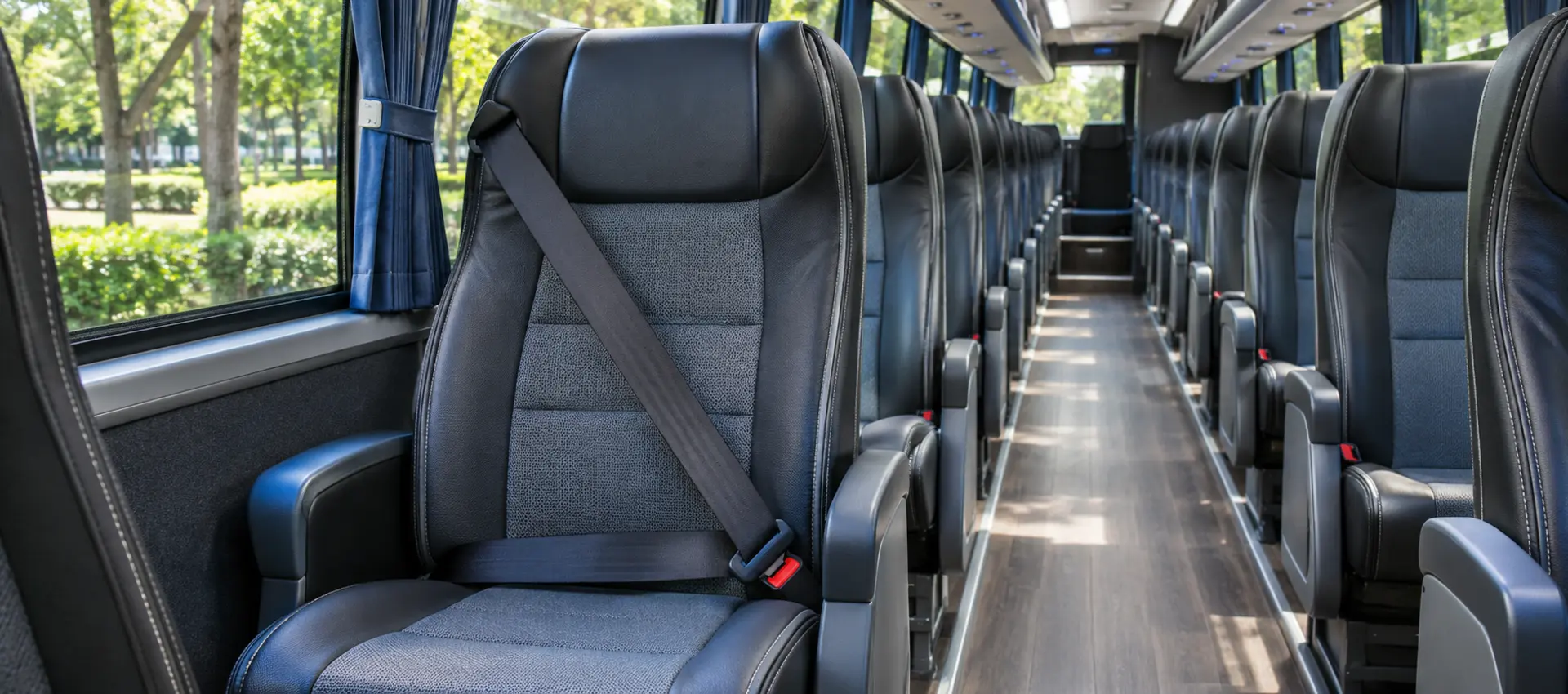
Start With a Safety-First Rental Plan
Arranging group transportation requires more than choosing a vehicle and confirming a date. A safe bus rental in the Bay Area affects passenger safety, accessibility, scheduling, luggage storage, pickup access, and emergency response. These considerations become more complex when a trip crosses multiple Bay Area cities or involves schools, employees, athletes, or event guests.
Use this checklist to verify the operator, assigned driver, vehicle, itinerary, contingency plan, and contract terms before committing. Each step helps you document expectations and make an informed transportation decision.
Verify Driver Qualifications and Screening
Ask the operator to confirm that the assigned driver holds the commercial credentials required for the vehicle and trip. Professional operators should use drivers with valid commercial driver’s licenses, completed background screening, and ongoing safety training. Request written confirmation rather than relying on a general statement about driver quality.
For school or youth transportation, ask whether the itinerary requires school-trip-specific credentials. The available guidance identifies School Pupil Activity Bus certification, commonly called SPAB certification, as relevant to school transportation. Confirm whether the certification applies to both the driver and vehicle, then request supporting documentation.
Ask for these items before booking:
- Written confirmation of the driver’s required commercial qualifications
- A summary of the operator’s driver-screening policy
- Confirmation of ongoing safety and emergency training
- Any school-trip-specific certification required for the itinerary
- The procedure for receiving the driver’s name and vehicle identification before departure
You also need a reliable way to recognize the correct bus and driver at pickup. Confirm when the operator will provide the vehicle number, license plate, driver name, and trip-day contact details. FMCSA’s bus safety guidance can help you prepare related questions about credentials and training.
Check Vehicle Inspection, Maintenance, Licensing, and Insurance
Vehicle condition, operating authority, insurance, and maintenance records require separate verification. Ask the operator for current licensing and insurance documentation, along with evidence of the applicable operating authority. For Bay Area service, request confirmation of relevant USDOT and California Public Utilities Commission compliance.
Ask for evidence that the assigned vehicle has received a recent safety inspection. The documentation should identify the vehicle wherever possible, rather than describe the fleet in general. You can also request a written explanation of the preventive-maintenance process, including how the operator records repairs and resolves defects before dispatch.
Charter operators should follow applicable Department of Transportation requirements and established maintenance procedures. Avoid assuming that a clean passenger cabin proves the mechanical condition of the bus. Appearance, inspections, maintenance, licensing, and insurance are different checks.
Before signing, request:
- Current operating licenses and authority
- Current commercial insurance documentation
- The assigned vehicle’s recent inspection record
- A description of the preventive-maintenance schedule
- Confirmation that reported defects are reviewed before departure
Keep copies with the trip file. If a document expires before the travel date, ask how the operator will provide updated proof.
Confirm Emergency Procedures and Trip-Day Communication
Ask how the operator manages medical incidents, vehicle problems, delays, route changes, and after-hours concerns. The response should identify specific procedures and contacts rather than provide a broad assurance that support is available. Confirm the following:
- The bus carries appropriate first-aid supplies.
- The driver receives emergency and evacuation preparation.
- Dispatch support is available during the trip.
- The driver has two-way communication with the operator.
- The operator has an escalation process for breakdowns and delays.
- The group can report an urgent itinerary change promptly.
- After-hours support instructions appear in the booking documents.
Ask whether the assigned bus supports GPS tracking or real-time location information. Treat this as a feature to verify because availability can depend on the vehicle and operator. If location sharing is available, clarify who can access it and how the trip organizer receives updates.
Name one decision-maker for the group and obtain the operator’s trip-day contact. Both sides should have each other’s telephone number before departure. Include a secondary contact if the primary organizer will travel without reliable phone access.
Match the Bus to Passengers, Luggage, and Accessibility Needs
Confirm the final passenger count before reserving a vehicle. Then describe all luggage, sports equipment, presentation materials, mobility devices, or other large items. The assigned bus must accommodate both riders and their belongings without overcrowding seats, aisles, or boarding areas.
Share mobility and boarding needs early. If a passenger uses a wheelchair or another mobility device, provide its relevant details and ask the operator to confirm a suitable configuration in writing. Include any need for boarding assistance.
Wheelchair-lift availability, luggage storage, and restroom access can vary by vehicle. The agreement should identify the assigned vehicle and confirmed features instead of relying on a general vehicle class. The operator’s information about coach bus features explains why capacity, amenities, accessibility, and storage must be addressed during planning.
Vehicle selection must also account for destination access. Narrower or winding roads around locations such as Santa Cruz or Gilroy may affect which vehicle is appropriate. Give the operator exact destinations so it can assess access before assigning the bus.
Plan Bay Area Pickups, Routes, and Backup Arrangements
Prepare a complete itinerary before requesting a final quote. Include exact pickup and drop-off addresses, every planned stop, arrival and departure times, and the full return schedule. Precise locations help the operator account for grades, narrow streets, loading restrictions, and parking constraints.
Use a complete itinerary for quote planning that covers:
- Pickup and drop-off addresses
- Intermediate stops
- Venue or hotel staging instructions
- Planned arrival and departure times
- Airport and flight details, where applicable
- Parking and toll arrangements
- A safe passenger loading zone
- The late-night return procedure
Confirm where passengers will wait and who will supervise boarding. A legal stopping point may still be unsuitable if passengers must cross busy traffic or carry equipment a long distance. Create a brief contingency plan as well.
Identify who can approve schedule changes, how the operator will communicate an access or parking change, and what happens after an unexpected delay. Give the driver and dispatcher the group’s emergency contact, while ensuring the organizer has the operator’s after-hours number.
Compare Written Quotes Without Compromising Safety
Compare written proposals by their documented safety and operational terms, not solely by the total price. Each proposal should identify the assigned vehicle, capacity, itinerary, addresses, times, accessibility arrangements, amenities, support contacts, and contractual conditions. Review the total price alongside its inclusions.
Ask whether fuel, driver time, mileage, parking, tolls, and any overnight-driver arrangements are included or handled separately. The written terms should also state the deposit schedule, cancellation conditions, overtime rules, and process for approving itinerary changes. Use this table to keep every proposal under the same level of review:
| Checklist item | Proof or written confirmation | Quote detail to compare |
|---|---|---|
| Driver qualifications | Commercial credentials, screening and training confirmation; applicable school-trip certification | Assigned driver and required qualifications |
| Maintenance and inspection | Recent inspection evidence and preventive-maintenance process | Assigned vehicle, condition and substitution terms |
| Licensing and insurance | Current authority and insurance documentation | Validity through the trip date |
| Emergency communication | Dispatch contact, communication and escalation procedures | Support for delays, breakdowns and changes |
| Accessibility and capacity | Vehicle configuration, boarding arrangements, storage and amenities | Fit for passengers, mobility devices and equipment |
| Itinerary and pickup logistics | Addresses, stops, times, staging, parking and return plan | Mileage, driver time, tolls and change handling |
| Contract terms | Deposit, cancellation, overtime, payment and substitution policies | Total price, separate charges, deadlines and responsibilities |
Resolve missing or conflicting information before paying a deposit. If a salesperson makes a material commitment by telephone, ask for it to be added to the proposal or contract.
Use the Checklist Before You Reserve
Verify the operator’s authority, insurance, driver credentials, screening, and maintenance documentation first. Confirm that the assigned vehicle fits every passenger, mobility requirement, amenity request, and piece of luggage. Finalize Bay Area addresses, loading areas, timings, parking, return details, and contingency procedures.
Then place every commitment, inclusion, contact, and contract term in writing before payment. This sequence helps groups evaluate transportation options through documented safety and operational information.
Plan Your Group Transportation
Ready to organize your trip? Request a personalized QAT charter quote for 20 or more passengers. Include your full itinerary, passenger count, and any accessibility or equipment needs. For booking policies, see QAT’s frequently asked questions.